
A Profound Situation
Living, dreaming, dying

“I didn’t plan for this,” my father says, pondering how the time remaining to him will be measured in months, not years.
After a bit, he sighs and says, “A profound situation.” And after another pause, “Grist for the mill.” He’s referring to me, because he knows I will write about this moment, and that’s okay; he approves.
It’s just the two of us, and we are in Miriam Hospital, in Providence, RI, a day or two after the kind young doctors on the palliative care team told him how little life he had left. He was shocked at the time.
My father is 95 at this moment, with a failing heart.
I ask him if he has any regrets, any unfinished business, anyone he wants me to reach out to. No. He says he did everything he wanted to do in life, especially having a family, and earning his pilot’s license, to fly a four-seater Cessna for fun, for nearly 50 years.
Nonetheless, he doesn’t wanted to talk about dying. He wasn’t a church-going man, and we never spoke about what he thought happens after death. After a week at Miriam, he will spend the remaining two months of his life living in a skilled nursing facility. He will never be able to go home. He will have many good conversations with his four children and his wife (our Mom), but not once will he acknowledge that he is a short-timer.
When I was very, very young, I sometimes existed in a dream-like state. I remember floating down the stairs in our house with a bright light (I told my mother about this, and she gently responded, saying I must’ve imagined it), and another time hearing beautiful music coming from the air, while standing in the sun in our mud room. To me, each moment was absolutely real.
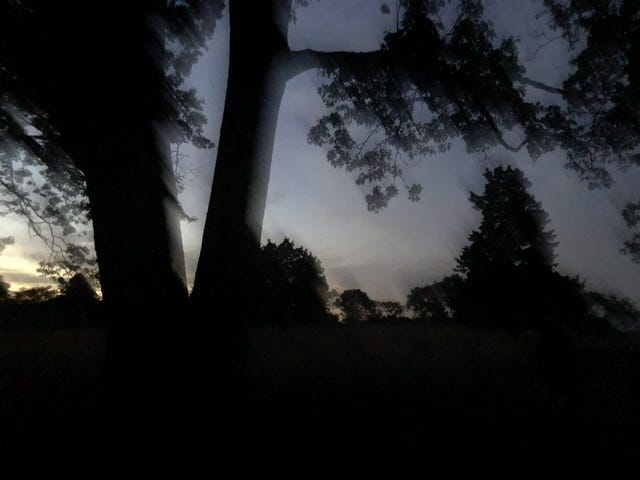
Some weeks after the “grist mill” conversation, my father is dreaming—he points to a bureau that isn’t in the room and asks my sister and me to find this thing in a bottom drawer underneath the tablecloths and throw it away. He says he has important paperwork to do; he needs to get things in order. He’s not entirely wrong, and I can see the logic in his dream-thoughts. We tell him, of course, we will do this.
He rallies from this round of dreaming—caused by an infection—but later, at the tail end of his life, begins again. One morning, he asks the hospice nurse when the wash will be done. Puzzled, she plays along and says 40 minutes, why? He says it’s loud, because he’s sitting on top of the machine. She tells me this later, and I get it; his oxygen machine is noisy, and as it cycles, it does sound like the washing machine we had growing up.
I think often about how my Dad didn’t know—when he took that ambulance ride to Miriam—that it was the last day he would take a shower by himself, or walk unaided, or get to be at home, or simply alone. This is one of many smaller heartbreaks I feel after his passing.
Another one—my father hadn’t been to my home since my husband and I hosted Thanksgiving, in 2019. The pandemic hobbled all of us, one of my brothers bought a beautiful house nearby which was easier for him to navigate with nascent Parkinson’s disease, and my parents moved, which took up a huge chunk of their time and energy. Again—there was a “last time,” and I didn’t see it until later. I’m not sure why this hurts so much—maybe because I kept thinking we’ll do this again someday, then almost five years went by, and now there is no “someday.”

My father sparked my love of finding treasures; arrowheads, coins, old bottles, sparkly rocks, sea glass. Any time my parents came to visit, I’d pull out my recent loot, and he’d want to hear the stories of how I found various things. Or we’d talk about gardening, another love that he gifted to all of his children. Every day now, there is some little thing I see or find, and think to tell him about, only to snap out of my reverie and recall with a start that he is gone.
Towards the end I think of him as “my little Dad,” because he is wasting away. I feel protective of him. I don’t want him to live forever, so I must accept that he will die. We should all die—the alternative (fading away, and away, and away) is much worse.
“You don’t have to be strong,” the nurse tells me.
I’m not. I can’t pretend.
In the last day of his life, when he is no longer fully conscious, I sit on my living room floor and breathe, partly to keep the grief and stress out of my miserable upset stomach. I feel the air going in and out of my nose, and I try to let everything move through my body instead of pushing it down and locking it in.
I see my father as points of light, beginning to disperse, like fireflies in a meadow. He is gradually moving away from us, separating, changing from a concrete individual to stars across the cosmos, and in my mind’s eye I see the lights moving beyond the outline of his bed-bound body.
I sense him moving towards peace, even as I am moving deeper into grieving. I feel this peace comes from outside of me, and I wonder if it flows from my Dad. Because I am definitely sitting in the pain of losing him.
I tell him—out loud—
It’s okay to go if you want to.
Your family knows you love us so much.
We love you, and miss you.
And we will get through it, together.
This is so beautiful, Maura.